
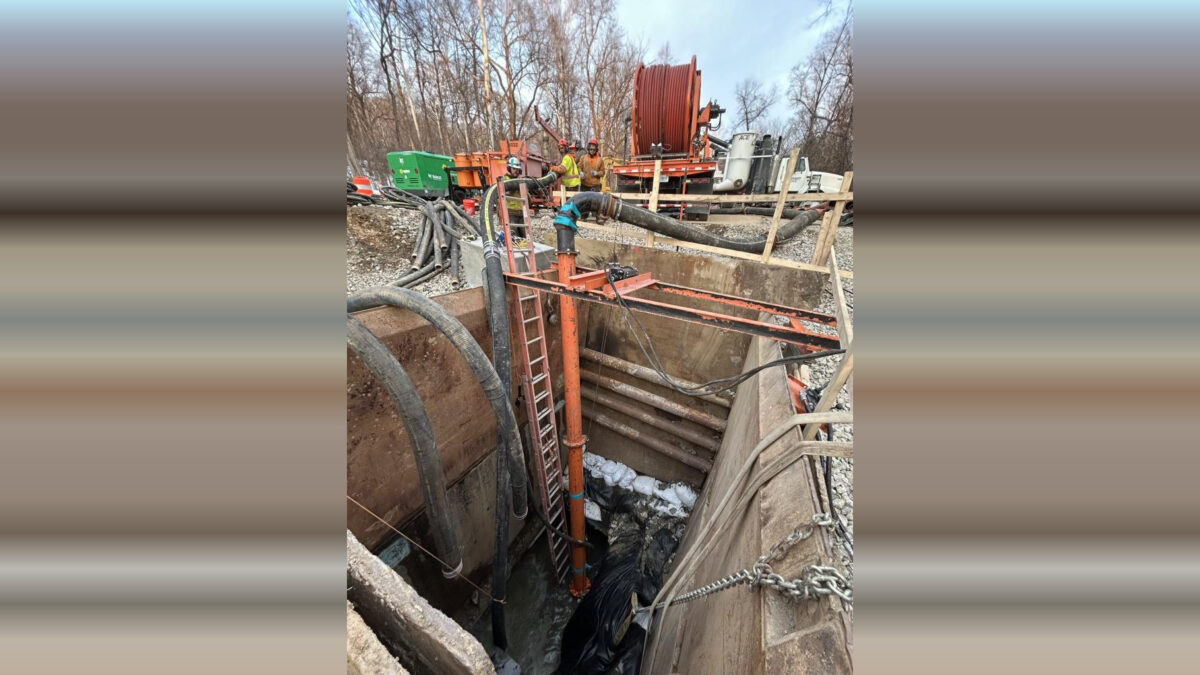
The broken sewage pipe near Cabin John has spewed an estimated 243 million gallons into the Potomac River, DC Water officials told Maryland lawmakers during a Friday briefing.
The overflow was at its worst from Jan. 19 to Jan. 24. After that, crews managed to mostly contain the spillage within a portion of the C&O Canal, preventing it from reaching the Potomac River and then the Chesapeake Bay, said Matt Brown, chief operating officer and executive vice president of DC Water, which manages the broken infrastructure.
But there have still been overflow events of untreated sewage into the environment, including on Super Bowl Sunday, when Brown said that two machines pumping sewage became clogged with so-called “flushable” wipes, and an estimated 600,000 gallons of sewage was spilled.
DC Water officials said Friday that they expect it will take four to six more weeks to bring flow back into the pipe, and nine months to fully repair the more than 60-year-old broken pipe, called the Potomac Interceptor, which takes in waste from Virginia communities near Washington Dulles International Airport, as well as from Montgomery County, and transports it to the Blue Plains Wastewater Treatment Plant.
During Friday’s briefing, Maryland delegates — and clean water advocates — discussed their worries for the future of the river, and how it will be perceived by the public.
Testing for various types of harmful bacteria have shown levels far exceeding Environmental Protection Agency thresholds in the area of the river closest to the break, though results improve, and fall below the threshold, moving downstream toward National Harbor, said Rachel Rosenberg Goldstein, an assistant professor of global, environmental and occupational health at the University of Maryland.
But there is a concern that the thawing of the river could allow more bacteria to travel downstream in the future, Rosenberg Goldstein said.
“There’s a lot of dynamics in terms of the changing temperature, the changing season, the snow melt,” Rosenberg Goldstein said. “We really want there to be continued monitoring, so we can understand what the water quality is over time.”
Brown said that DC Water is conducting daily testing, and plans to continue that for “some period of time,” but it hasn’t determined how long that will continue.
During the hearing, Potomac Riverkeeper Dean Naujoks said that during his initial trips to the site, he quickly began to grapple with the large scale of the disaster.
“Having done this work for 25 years, I already knew that this was quickly becoming one of the larger spills, if not the largest sewage spill in U.S. history,” Naujoks said.
He expressed concern that because DC Water officials have listed the spill as contained, some members of the community wrongly believe that the river is safe to come into contact with, though data shows that bacteria levels are still high near the site of the spill. His organization has received messages “on a daily basis” from residents asking questions about it.
“Last week there was DC fire fighters that were putting themselves at harm’s risk and going into the river and practicing drills in the ice. And they’re contacting us and asking us if the river’s safe,” Naujoks said.
Virginia officials released a public health advisory for the river Friday, though Maryland officials had released advisories considerably earlier.
Naujoks pushed for monitoring efforts to continue into the summer, to supply the public with data that will allow them to trust the river, as long as the data suggests that they can.
“It’s really important to understand, we’re getting messages every day from people saying, ‘Hey, I’m not letting my kid row crew this year,’” Naujoks said.
Betsy Nicholas, president of the Potomac Riverkeeper Network, noted during the hearing that unanticipated large pollution events such as the sewage spill are not accounted for in computer modeling that predicts water quality in the Chesapeake Bay, which already shows that states are lagging behind in reducing pollution into the estuary.
“This one… is going to have a long-term impact on the health of the river and the Chesapeake Bay,” she said. “Essentially it’s like having a great big major wastewater treatment plant loading into the bay.”
As delegates peppered panelists with questions, Del. Jay Jacobs (R-Eastern Shore) worried about how fisheries in the Potomac River would be impacted by the public’s perception of the Potomac. The river includes a vibrant fishery for invasive blue catfish, as well as oyster harvesting.
“Once an event like this occurs it really turns people off quick,” Jacobs said.
Discover more from The Free State Press
Subscribe to get the latest posts sent to your email.