
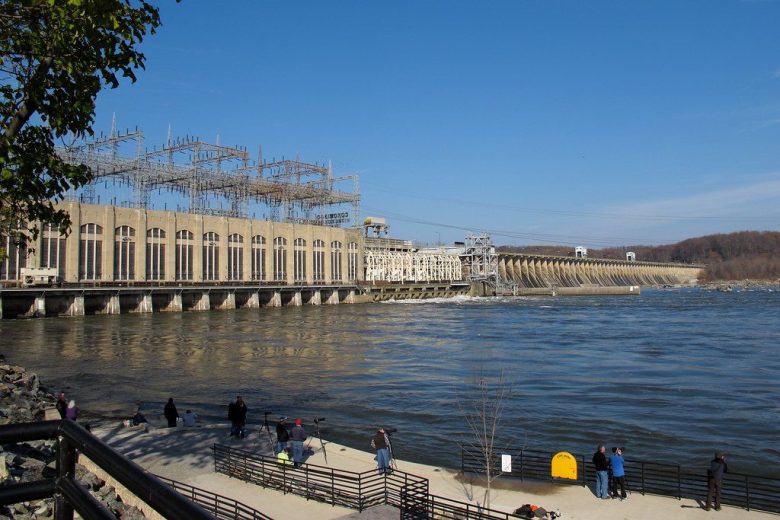
A coalition representing at least two Eastern Shore counties has appealed the water quality certification Maryland issued to the Conowingo Dam in September, potentially threatening a $340 million settlement with the dam’s owners.
The Clean Chesapeake Coalition’s administrative appeal, filed Nov. 14 with the Maryland Department of the Environment, argues that the years of contentious negotiations that led to the settlement were conducted behind closed doors, freezing out groups like the coalition. That has enraged the county leaders backing Clean Chesapeake’s complaint.
“That’s really why this appeal was filed, is because we heard nothing about this until the deal was done,” said Charles “Chip” MacLeod, the attorney who filed the complaint. “We don’t know whose comments they considered and to what extent they considered [them]. None of that. We’re totally outside the process.”
MacLeod argues that MDE’s procedure violated state law, rendering the certification invalid. And he said the counties also believe that the resulting agreement will not protect the health of the bay, in part because it does not require dredging behind the dam.
State environmental officials, however, argue that the agreement has tremendous implications for the bay, and the discussions had to be confidential because they concerned litigation brought against the state by groups opposed to an earlier agreement, in 2018. The officials highlight the fact that the state solicited public comment about the dam in 2023 — and took those comments into account. Maryland Gov. Wes Moore (D) shakes hands with Joseph Dominguez, CEO of Constellation Energy, the owner of the Conowingo Dam at a news conference on Oct. 2, 2025 about the dam’s revised water quality certification issued by the state. (Photo by Christine Condon/ Maryland Matters)
“We are puzzled by the timing of this submission, as public comment occurred in 2023 as part of a seven-year effort over two administrations,” wrote Department of the Environment spokesperson Jay Apperson. “The input from county partners led to the provisions that address dredging that did not exist in the previous agreement.”
MDE officials will evaluate the complaint and “respond as appropriate,” Apperson said.
At issue is the water quality certification the state issued Constellation Energy, which owns the hydroelectric dam spanning the Susquehanna River just north of where it enters the bay. Without the certification from the state, Constellation cannot pursue a 50-year license from the Federal Energy Regulatory Commission needed to operate the hydropower plant.
The nearly century-old dam once helped the ecosystem by trapping harmful sediments rushing downstream. But the pool behind the dam has become full, so it no longer has trapping capacity. That means a severe storm could unleash large quantities of sediment into the bay at once, which could smother critical underwater life.
The certification from the state — and the multimillion-dollar pledge from Constellation — was the result of several years’ worth of contentious negotiations between the state and the parties that had challenged the 2018 version of the certification, Constellation and two local waterkeepers’ groups.
Under the latest deal, Constellation agreed to pay the state about $340 million over the years for a variety of environmental initiatives, supporting everything from a new mussel hatchery to debris clean-ups and $18.7 million for dredging studies.
Appeal could slow dam’s pursuit of 50-year license from the feds
“The agreement came after years of difficult negotiations that brought the Conowingo Dam’s water quality certification process to a conclusion in a manner that protects the Chesapeake Bay and ensures the continued operation of Maryland’s largest renewable energy source,” wrote Paul Adams, a spokesman for Constellation. “MacLeod’s filing risks to delay the implementation of this historic agreement and the many investments to protect Chesapeake Bay.”
Apperson called it “reckless” for the coalition to “come in at the end of the process and try to halt real progress for Maryland.”
“Disrupting this process will only delay or possibly remove dredging and other water quality projects because it will plunge us back into even more years of delay with no action,” Apperson wrote.
In his filing, MacLeod raised other deficiencies with MDE’s certification.The Constellation Energy building in Baltimore’s Harbor Point. (Photo by Christine Condon/Maryland Matters)
He said that the department failed to adequately explain the departure from the 2018 agreement, which would have required the dam owner (then Exelon, Constellation’s former parent company) to pay up to $172 million each year, if it could not meet requirements to reduce sediment overflows.
He also wrote that MDE failed to sufficiently consider the effects of climate change, or new information like the recent decline of the Chesapeake Bay’s striped bass population, when it issued the certification to Constellation.
“Who, with a straight face, can’t say there isn’t a lot of new data and information to consider since 2018, as it relates to Chesapeake Bay water quality issues, right?” MacLeod said. “We know a lot more.”
He wrote that MDE should have considered the dam’s structural integrity when it issued the certification, pointing to FERC documents “addressing structural and monitoring issues,” including some faulty piezometers, which measure pressure on the dam, and vegetation growing in inappropriate areas.
Despite that, an August report from a FERC engineer said that, “No signs of immediate dam safety concerns were observed,” during a late-July inspection.
Constellation argues that recent inspections show Conowingo is structurally sound. The company conducts careful maintenance of the dam, Adams said, which was “built to last,” and has 93 “fully operational” piezometers. He said Constellation is consulting with FERC on a plan to add 32 more.
“FERC and Constellation regularly correspond on the subject of dam safety, which is a sign of a regulatory process that is working well and as intended,” Adams wrote.
MacLeod said that if MDE rejects the appeal, he would consider a court challenge, if he got adequate support from the counties.
He said officials in Cecil, Dorchester, Kent and Queen Anne’s counties support his petition. Leading officials in Cecil and Dorchester confirmed their support. Queen Anne’s did not immediately respond to a request for comment.
The Kent County Commissioners, meanwhile, have yet to vote. But Ronald Fithian, president of the commissioners, said Kent has been a longtime supporter of the Clean Chesapeake Coalition, and he expects the three commissioners to support MacLeod’s complaint when the item hits their agenda in the coming weeks — along with a $5,000 payment to MacLeod to support the effort.
MDE tries to sway reluctant officials
With the administrative appeal under consideration, MDE officials are lobbying at least one of the opposing counties to back down.
On Tuesday, MDE officials traveled to Dorchester’s County Council meeting to advocate for the agreement — and warn about the negative consequences of an appeal.
“Any legal challenge doesn’t just pause the paperwork,” said Heather Nelson, Wetlands & Waterways Protection Program manager at MDE. “It’s freezing the funding. So all payments for mussel restoration, dredging analysis and mitigation projects are going to be stayed.”
State officials are also concerned that the Environmental Protection Agency appears very close to making changes to Section 401 of the Clean Water Act, which gives state governments the authority to issue certifications like the one issued to Constellation.
If the federal government restricts states’ authority, and the Conowingo certification is hung up by appeals, it could put the agreement at risk, meaning Constellation wouldn’t be required to make any payments to Maryland.
How many years have we been waiting to know the dredge is a problem behind the dam? But we’re going to study it, and they’ve got another 50 years before they’ve got to dredge. So guys, I am not for this program right now that you’ve got. I’m sorry.
– Dorchester County Councilman Richard Travers.
Delays could also cause FERC to issue the 50-year license with none of Maryland’s conditions, Nelson said.
“That’s a very real risk,” Nelson said. “So the legal stakes are incredibly high, and the delays risk that we end up with just years of litigation and zero environmental improvements at the dam.”
But MDE’s arguments did not seem to resonate with Dorchester officials, most of whom continued to oppose the agreement.
“How many years have we been waiting to know the dredge is a problem behind the dam? But we’re going to study it, and they’ve got another 50 years before they’ve got to dredge,” said Councilman Richard Travers. “So guys, I am not for this program right now that you’ve got. I’m sorry.”
Deputy Environment Secretary Adam Ortiz told the council that the additional studies are likely needed to try and lower the cost of dredging behind the dam, including by studying beneficial reuse for the sediment and heavy metals stuck in the reservoir. For example, Ortiz said that, with a lowered price, the federal government could be swayed to contribute.
“I wish we could get it out of Constellation. We did not have the legal authority to do that. So, this is the path: To make sure it’s economically viable, to see what’s in the sediment that is of value, that we’re able to extract and then resell,” Ortiz said.Adam Ortiz, a deputy secretary at the Maryland Department of the Environment, speaks at a news conference in Essex on April 15, 2025. (Photo by Christine Condon/ Maryland Matters).
The agreement between MDE and Constellation lets the department use the $18 million to conduct studies, or to take other actions, like to begin evaluating a dredging permit for the site. All parties are waiting for a key study from the U.S. Army Corps of Engineers, expected in late 2026 or early 2027.
Cecil County spokesperson Robert Royster said in a statement that the county is “extremely troubled by both the lack of transparency in these negotiations and the pressure being applied by the state to accept the agreement before we fully understand its implications.”
“Cecil County is deeply concerned that this settlement was negotiated in secret, without any consultation or input from the counties most directly affected,” Royster wrote.
He added that the county’s water intakes south of the dam, including in Perryville, Port Deposit and Havre de Grace, “continue to experience significant impacts from sediment and debris trapped behind the Conowingo Dam.”
Kent County Commission President Ronald Fithian said his personal experience as a waterman tells him that more needs to be done at the dam. He still remembers Hurricane Agnes in 1973, when the dam opened its gates and clouded the bay in massive quantities of sediment.
“That thing shut the bay down for probably at least three months after the storm, for any type of harvesting,” Fithian said. “The sediment that come down was just unbelievable.”
But the issues didn’t stop with Agnes. Especially now that the dam’s reservoir is full, he fears that it is continuing to unnaturally eject sediment into the Upper Bay — diminishing the area’s oyster industry.
He thinks Constellation should be compelled to dredge behind the dam. And he balks at the $18 million allotment to study the idea, because prior studies have come and gone with no action.
“It’s gone unattended. They’ve let it fill up. So now, we get all of the sediment, nutrients — all the nasty things that might be coming down the Susquehanna River,” Fithian said. “We get it all. And the bay just can’t keep up with it.”
Maryland Matters is part of States Newsroom, a nonprofit news network supported by grants and a coalition of donors as a 501c(3) public charity. Maryland Matters maintains editorial independence. Contact Editor Steve Crane for questions: editor@marylandmatters.org.
Discover more from The Free State Press
Subscribe to get the latest posts sent to your email.